Universidad 2026 #Research Article

UNIVERSIDAD 2026 – Global Alliances
THE GLOBAL ALLIANCE OF INNOVATIVE SCHOOLS
By Jinkyo Choi
Founding Principal of Next Challenge School and Vice President of the Next Challenge Foundation
Alliance and Beyond: The Cross-Border Eco-system of Innovative Schools
Author’s note:
This article draws on the author’s experience hosting and curating the Innovative Universities Summit (2024) and Innovative Schools Summit (2025)—global gatherings that convened visionary educators, founders, and policymakers to explore the future of learning.
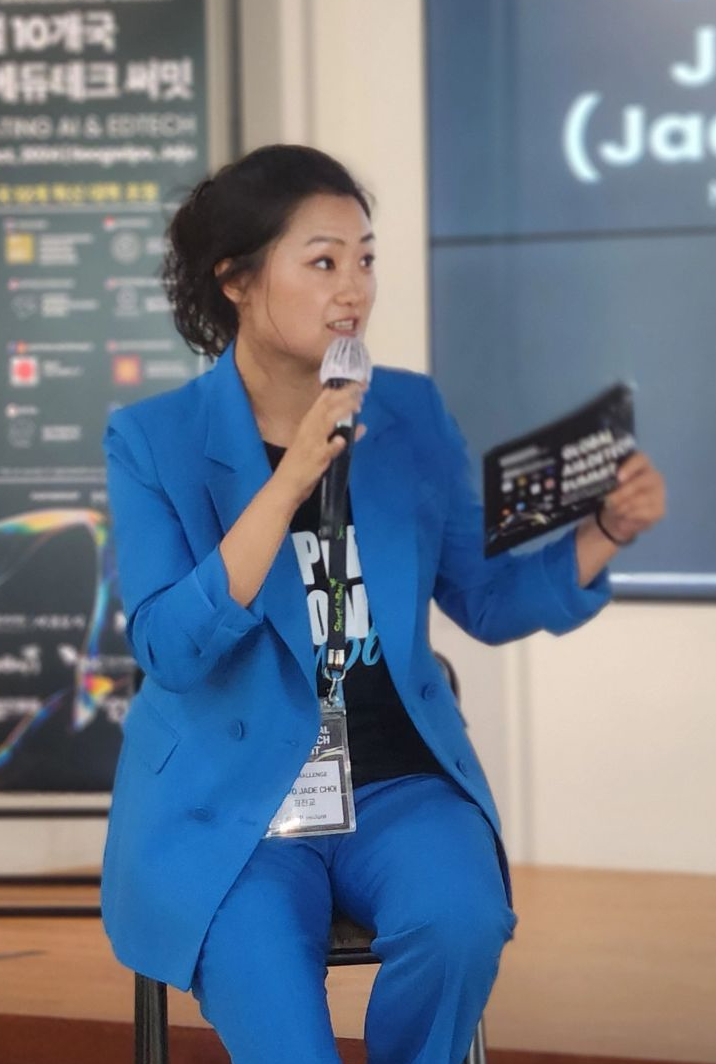
As the Founding Principal of Next Challenge School, a world-traveling startup school, and Vice President of the Next Challenge Foundation, the author has led the creation of the Global Alliance of Innovative Schools (GAIS).
Her work centers on building cross-border ecosystems where education, entrepreneurship, and cultural exchange merge—pursuing a simple belief that learning becomes most powerful when it moves beyond borders and bridginging the silos.
A New Urgency for New Models in Education
As humanity approaches the threshold of the technological singularity, disruption is no longer confined to individual industries — it is reshaping the very fabric of civilization. Automation, artificial intelligence, and humanoid technologies are not only transforming how we work, but also redefining why we work. Categories of employment are dissolving, while new forms of value creation emerge at the intersections of humans and machines.
In this shifting landscape, education can no longer rely on the Industrial Age logic of predictable careers and technical specialization. The challenge before us is to cultivate entrepreneurial and transferable skills — mindsets that allow individuals to adapt, create, and collaborate within evolving ecosystems. This is why new models of education are necessities: a collective response to a world where learning itself must become dynamic and inventive-.
The Global Alliance of Innovative Schools
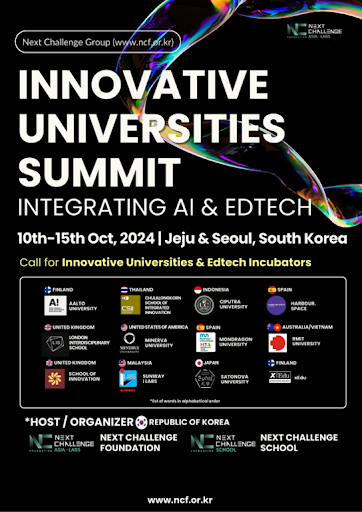
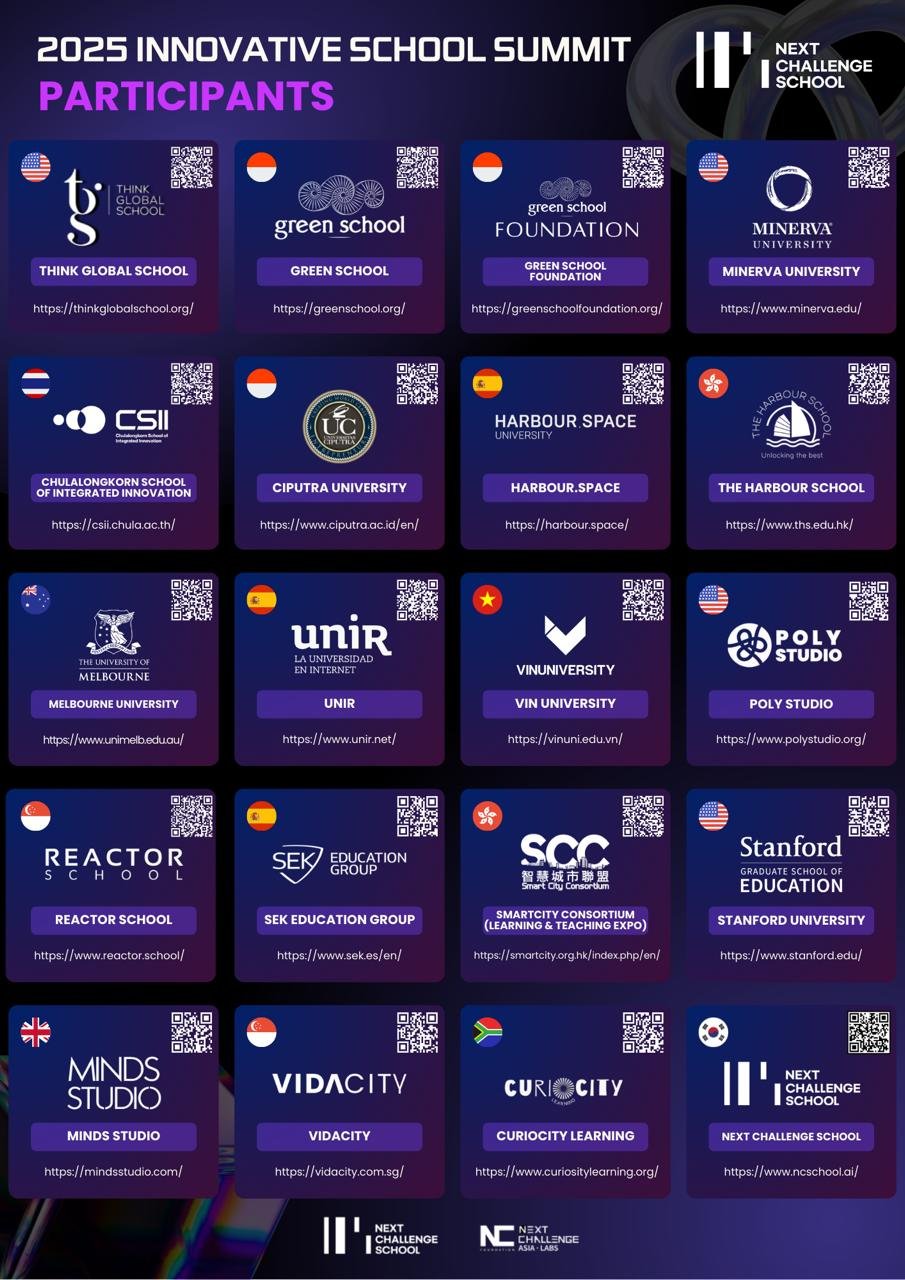
Over the past two years, the Innovative Universities Summit (2024) and the Innovative Schools Summit (2025), hosted by Next Challenge School & Next Challenge Foundation, have gathered pioneering educators from more than twenty institutions across five continents — from Minerva University in San Francisco to Green School Bali, from Aalto in Helsinki to African Leadership University in Kigali. What emerged from these encounters was not simply a collection of best practices, but a vision of education as an ecosystem, one that transcends borders, sectors, and conventional hierarchies.
These institutions, collectively forming the Global Alliance of Innovative Schools (GAIS), reveal a new logic for the future of learning where universities and schools act less like isolated fortresses of knowledge and more like living networks that evolve with their societies.
Design Philosophy of the Summit
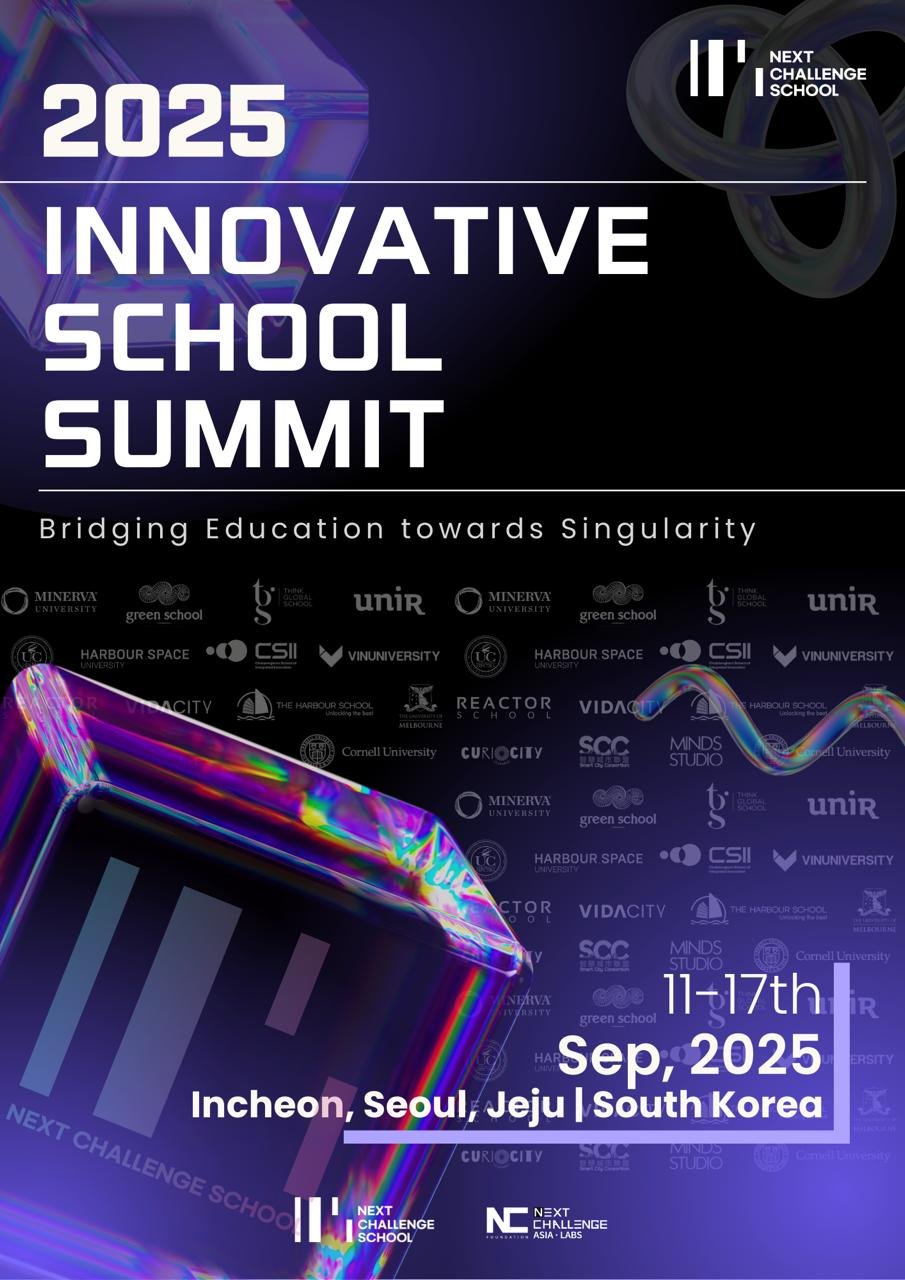
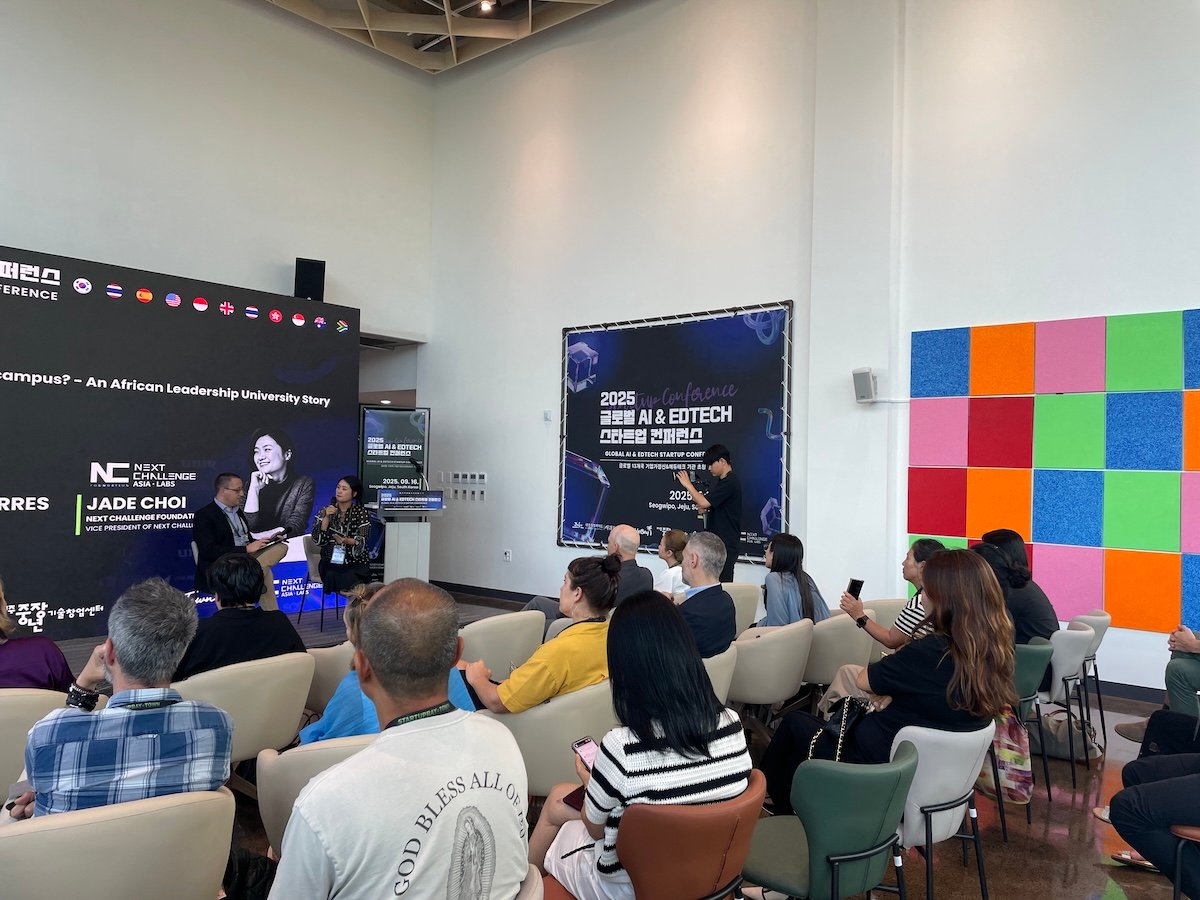
The Innovative Schools Summit was not intended to imitate the scale or formality of traditional academic conferences. Instead of hundreds of fleeting encounters, it brought together a small circle of around thirty education innovators — a size that allows for authentic dialogue and genuine collaboration. This intentional intimacy encourages participants to share ideas, challenges, and unfinished thoughts with rare honesty.
The summit’s traveling format — spanning Incheon, Seoul, and Jeju — embodies the belief that learning happens not in isolation, but in movement. Each city was chosen as a living case study of how education connects with culture, entrepreneurship, and community. The itinerary blended school visits and local partnerships with moments of reflection — a forest walk in Jeju, a historical tour in Seoul, a conversation with local students in Incheon — so that participants could feel the interconnectedness of education and place.
This experiential approach mirrors the spirit of the Next Challenge School, founded on the idea that students learn best when they travel, collaborate, and explore real ecosystems. The summit was not just an event; it was a prototype for the future of learning — where dialogue, immersion, and discovery form a single continuous experience.
Five Lenses of Educational Transformation
The following five perspectives drawn from the summit trace how this transformation unfolds across different geographies and philosophies: from rethinking what and how we learn, to using entrepreneurship as a tool for societal renewal; from regenerating communities through cooperation, to redefining who teaches in a post-industrial world; and finally, to localizing global innovation models into new educational geographies. Together, they offer a map of how the future of learning is already being built as an ecosystem.
1. Flipping the Axis: Transferable and Interdisciplinary Learning
For centuries, education has been defined by what students know; today, the leading innovators redefine it by what students can do.
At Minerva University (USA), the curriculum is built on transferable skills — critical thinking, effective communication, and creative problem-solving — embedded across every discipline and assessed in authentic, real-world contexts. Rather than memorizing facts, students learn how to think across systems, adapting their knowledge wherever they go.
Similarly, the London Interdisciplinary School (UK) turns the question of how we learn into a radical experiment. Instead of traditional majors, students confront global problems — from climate change to misinformation — drawing methods from science, philosophy, and design. By learning through challenges, they move fluidly between domains, developing the intellectual agility that the new century demands.
Together, Minerva and LIS flip the academic axis: from content to cognition, from silos to synthesis. They embody an educational model where knowledge is not static but transferable, transdisciplinary, and transformative.
2. Entrepreneurship as a Tool for Social Impact and National Transformation
In another dimension of the alliance, universities use entrepreneurship not merely as an economic instrument but as a social technology — a means to transform communities and nations.
At the African Leadership University (Rwanda and Mauritius), entrepreneurship is framed as a moral act: a responsibility to design solutions that serve society. Students are trained not to seek jobs but to create systems of value in fields like clean energy, agritech, and civic innovation.
At Aalto University (Finland), the entrepreneurial ecosystem — born out of the merger between business, design, and engineering schools — has become a cornerstone of Finland’s innovation policy. The university’s collaborative platforms and student-led ventures have made Helsinki a hub where creativity meets technology, and where the national identity of resilience translates into a culture of making.
Meanwhile, Ciputra University (Indonesia) embodies how entrepreneurship can reshape an emerging economy. Founded within one of Indonesia’s leading business groups, Ciputra’s vision of “creating world-class entrepreneurs” aligns with the country’s demographic momentum and digital transformation. Its students are encouraged to build startups with social and regional relevance, turning entrepreneurship into a civic and developmental force.Across these cases, entrepreneurship becomes not the end goal but the medium of change — the mechanism through which education engages history, economy, and identity.
3. Regenerative, Cooperative, and Community-Based Models
If the previous models speak the language of innovation, this cluster speaks the language of regeneration — restoring balance between human progress and ecological well-being.
At Mondragon University (Spain), the cooperative model challenges the capitalist logic of competition. Students, faculty, and enterprises co-own the institution, learning that economic systems can be democratic and ethical. Education here becomes an act of shared stewardship, where value creation and value distribution coexist.
Green School Bali (Indonesia) takes this spirit into environmental practice. Its open-air bamboo classrooms are not symbols of rustic simplicity but of systemic learning — where sustainability is not taught as a subject but lived as a daily culture. Students design projects around waste management, renewable energy, and regenerative agriculture, discovering that the planet itself is both classroom and collaborator.
Together, Mondragon and Green School articulate an essential truth: that innovation is not only about moving faster but about moving more responsibly — weaving cooperation, ethics, and ecology into the DNA of education.
4. New University Graduates, New Teachers
In an age where knowledge evolves faster than curricula, the alliance recognizes that the next frontier of education innovation lies in who teaches.
Harbour.Space University (Spain/Thailand) offers a glimpse into this future. Its three-week modular system invites industry leaders, unicorn founders, and big-tech professionals to design and teach short, intensive courses. These are not visiting lectures but full academic experiences where practitioners transmit real-time expertise from the frontlines of technology and design.
The result is a fluid exchange between academia and industry, where teachers are no longer a fixed category but a rotating community of innovators. This approach redefines both sides: professionals learn to articulate and systematize their knowledge, while students encounter the immediacy and uncertainty of the real world.
The model suggests that the universities of the future will not be measured by the number of full-time faculty they employ, but by the breadth of expertise they can connect — producing a generation of graduates who are also capable teachers.
5. Cross-Border Innovation and Localization
The most dynamic transformation in the alliance emerges where education meets localization — when global ideas are reimagined through local realities.
In Malaysia, Sunway iLabs adopted the École 42 model of peer-to-peer coding education, but instead of simply replicating its Parisian structure, Sunway localized it within the Malaysian innovation ecosystem. The program integrates corporate mentorship, government partnerships, and regional startup support, turning a European experiment into an Asian engine for digital empowerment.
VinUniversity (Vietnam), co-developed with Cornell University, follows a similar path of contextual globalization. Its curriculum and faculty development draw from Cornell’s expertise but evolve through Vietnam’s entrepreneurial energy and collective ethos. What began as a partnership has matured into a hybrid institution — global in standard, local in spirit.
Harbour.Space University’s Bangkok campus, launched under Thailand’s Education Sandbox, in collaboration with UTCC, embodies regulatory innovation. By working directly with the government, it gained flexibility to design agile, industry-linked programs, demonstrating how public policy can become a partner in experimentation.
These cases reflect a new educational geography — not a West-to-East transfer of models, but a co-creation of knowledge. They show how localization, far from being a constraint, becomes the creative force that allows innovation to take root, adapt, and scale across borders.
Next Challenge: Building Education as a City Ecosystem
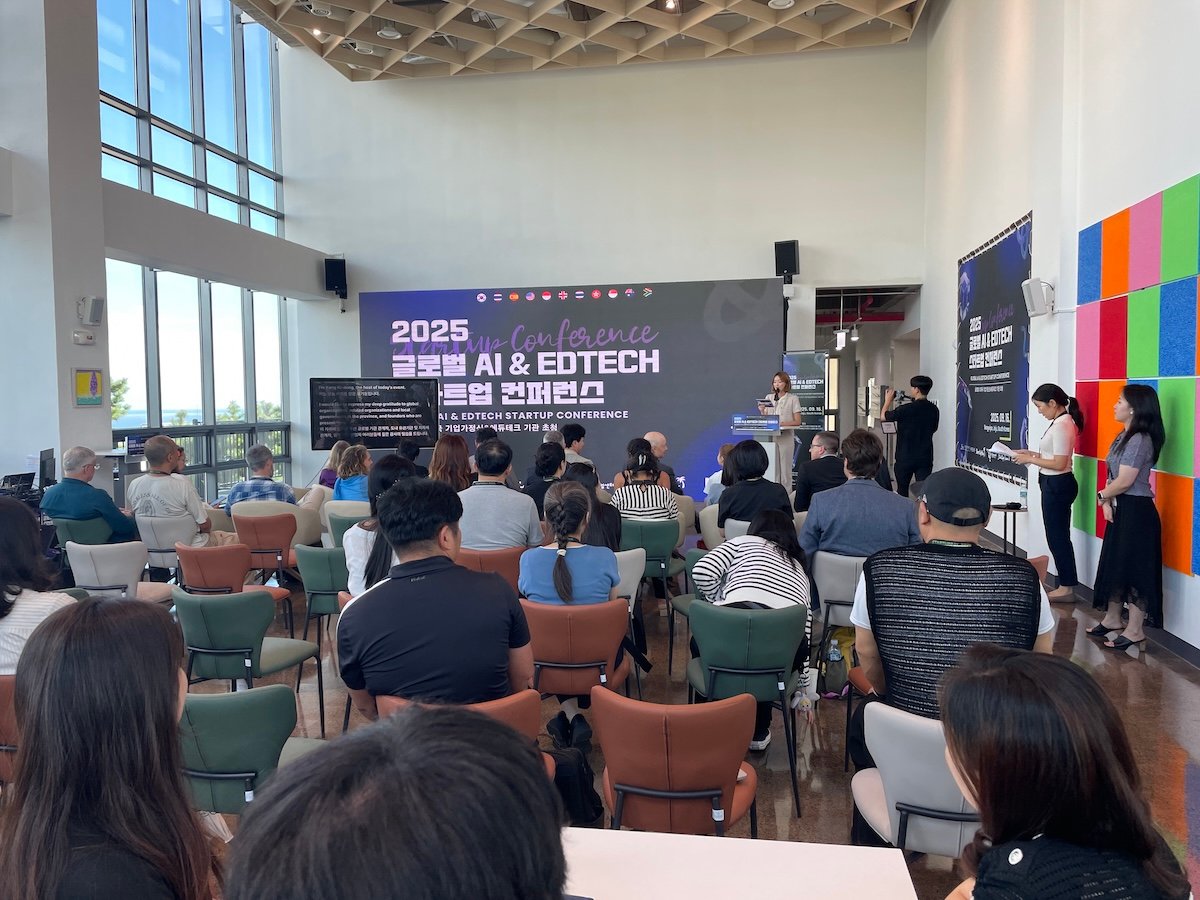
Amid these global movements, Next Challenge has been translating the alliance’s philosophy into practice at the city and ecosystem level. Its approach begins with infrastructure — creating physical hubs that act as collaborative anchors for learning, entrepreneurship, and innovation. From these hubs, the team works directly with local schools, teachers, and students, cultivating the spirit of creativity and problem-solving across communities. It is slow, deliberate work — yet foundational, because culture shifts through people, not policies.
The Next Challenge Foundation, as a startup accelerator and ecosystem builder, connects these educational roots to the city’s broader development engine: linking entrepreneurs, accelerators, public institutions, and government agencies. Together, they form a circular model of growth — nurturing young innovators, supporting ventures, and generating new jobs that, in turn, strengthen the local economy. Within this design, the Next Challenge School serves as a human incubator on the education pillar, while the Foundation builds the structural umbrella that keeps the entire ecosystem alive.
From Institutions to Ecosystems, Why it matters Now
The ecosystem approach in education is no longer optional; it is the architecture required for an age defined by complexity. The challenges – climate change, artificial intelligence, inequality, sustainability – are too interconnected for single-lens solutions.
Traditional education, organized around isolated disciplines and linear career paths, cannot meet problems that stretch across technology, ethics, governance, and culture. What is needed now are cross-industry and interdisciplinary systems that enable knowledge to circulate freely between education, research, entrepreneurship, and civic life. The ecosystem approach creates precisely that: an environment where collaboration replaces competition, and innovation becomes a shared civic responsibility. In such ecosystems, education ceases to be a pipeline feeding the labor market; it becomes the central nervous system of collective intelligence, enabling communities, cities, and industries to co-evolve.
This network of universities and schools does not compete for prestige; it collaborates for relevance. It is guided by the conviction that the future of learning will be defined not by uniformity but by connectivity, adaptability, and shared imagination.
The Alliance and Beyond initiative, born through the summits, demonstrates that when education operates as a collective intelligence — spanning nations, industries, and generations — it becomes more than a system of instruction. It becomes a living architecture of change, capable of reimagining the world it serves.
Alliance and Beyond: How to Keep the Wheels Going
The momentum of the summit continues through What Is Your Next Challenge?, a monthly virtual practice hosted by Minds Studio. Designed for participants of the 2024 and 2025 summits, the program aims to build community, provide peer support, and share collective learning across borders.
Each month, educators and innovators come together to discuss the real challenges of transforming higher education, exchange practical insights, and co-develop new approaches. Over time, these dialogues will grow into shared case studies and collaborative projects, extending the alliance’s impact well beyond the summit itself.
More than an online gathering, What Is Your Next Challenge? embodies the alliance’s essence: transformation sustained through connection — where learning, reflection, and innovation move forward together, one conversation at a time.
Author: Jinkyo Choi, Founding Principal of Next Challenge School and Vice President of the Next Challenge Foundation
This article is available in Spanish via Nueva Revista. Click HERE.
Universidad 2026 is a publication by:
Nueva Revista
Nueva Revista is a Spanish publication dedicated to analyzing contemporary society, focusing on culture, humanities, science, art, and politics. It offers in-depth analysis and expert perspectives on topics such as higher education innovation, technological advancements, social change, and public policy. Featuring contributions from renowned academics, writers, and thought leaders, the magazine fosters critical dialogue and intellectual debate, making it a key reference for those interested in the intersection of knowledge, society, and progress.
If you’d like to read this year’s edition of University 2025 in Spanish, please click below:

In collaboration with Proeduca
PROEDUCA’s objective is to provide the best online higher education to its students and it achieves this through educational commitments at three universities: The International University of La Rioja, the Online University of Mexico (UNIR Mexico), and CUNIMAD. It also offers studies located in Peru, at the Newman Postgraduate School, and in the United States, where it has a presence through MIU City University Miami.