
The Practice
At Minds Studio, we understand a community of practice as a group of people who share a concern or a passion for something they do and learn how to do it better as they interact regularly*, developing a sense of craftsmanship.
After years of experimentation in collaboration with education institutions, we have witnessed how the creation of communities of practice are one of the most powerful tools to help individuals develop their skills and sense of belonging.

Minds Studio as a Community of Practitioners
Minds Studio operates as a community of professionals who share a passion for learning craftsmanship, and we come together regularly to learn how to do it better. Within the Minds Network, there are several groups meeting regularly and sharing their findings under an Open Source license.
Our Current Framework
In order to be able to conduct our work, we have developed a common language that helps us explain the core of what we do, as well as the stakeholders involved. This is a living ecosystem that continuously changes as we keep running experiments and discovering new theoretical frameworks.
What’s a Studio?
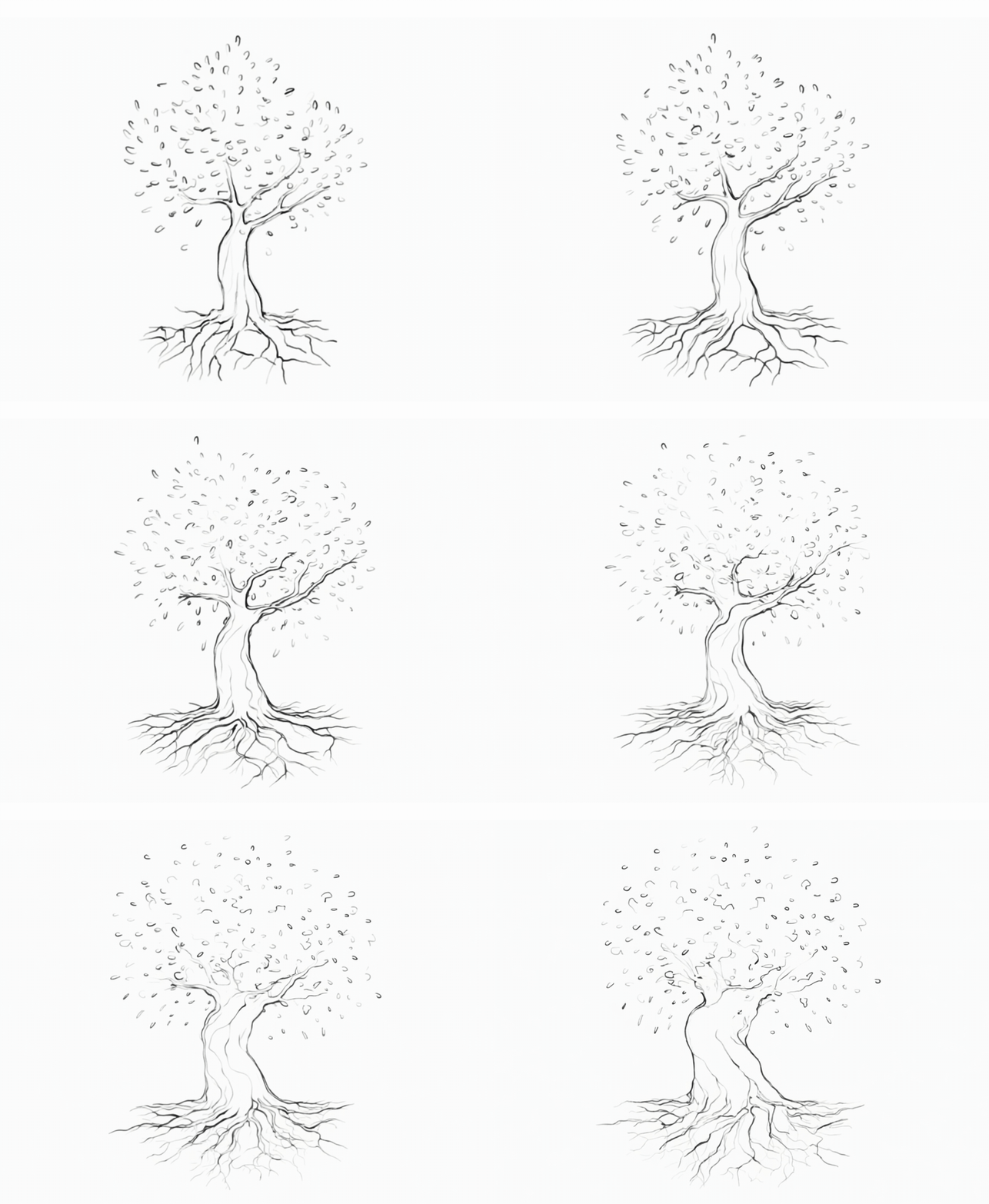
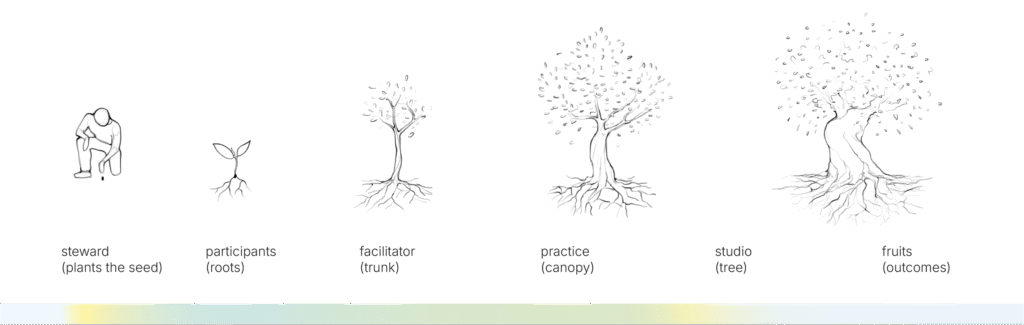
We define a Studio as a facilitated community of Practice, where Participants meet with a Facilitator following a framework designed for emergent learning. This gathering could happen in person or online.
Who is the Steward?
The Stewards identify a space where a Studio could sprout and flourish through providing the strategic focus and resources to nourish the Practice.
They ignite the initial spark that sets in motion a process of increasing engagement with Participants and Facilitators in novel and more meaningful ways.
They also provide the scaffolding and nourishment necessary for the community to reach its full potential. Observing nature, we realised the process of creating a thriving community of practice resembles nature’s cycles, so we’ve decided to follow them.

Who are the Participants?
The Participants are the lifeblood of the Studio. Their curiosity is the energy that keeps the community growing by showing up regularly to Practice.
They contribute their time, knowledge, perspective, experience, skills, attitude, beliefs, and stories. They are willing to be part of an unusual space where exploration and emergence replace rigidity and predictability.
When participating in a Practice, Participants receive the gift of a community of peers dedicated to growing and learning. They strengthen their existing abilities, stretch into weaker areas, and open up to completely unexpected paradigm shifts.
Who is the Facilitator?
The Facilitator orchestrates the learning experience, co-creating with the Participants a safe yet challenging environment that transcends traditional educational paradigms by
– gently fostering playful inquiry and collective discovery,
– holding space, listening deeply, and weaving together diverse perspectives
– encouraging them to lean into uncertainty and embrace the unexpected.
Facilitators are the catalyst of the Studio, fostering the conditions for emergent learning within the group, strengthening their abilities, venturing into new areas, and nourishing their curiosity.


What’s a Practice?
A Practice is the act of rehearsing a behaviour repeatedly, to help learn and eventually master a skill or way of being. A practice not only involves doing specific tasks but also encompasses ways of thinking, learning, and being.
We work in Seasons
Each Studio decides when to Practice with a commonly agreed Cadence and Season Length under a Theme. This allows the Participants to feel progress and enables the onboarding of new ones, which happens at the beginning of every Season.
Would you like to see how it works?
Schedule a call with our team if you’re curious how this could apply to your organisation.
Some of our Practices


Sources
**For theoretical frameworks, see Jean Lave, Etienne Wenger, “Situated Learning: Legitimate Peripheral Participation”