The Minds Studio Lighthouse

Lighthouse Letter VI

Spreading practices > scaling products

By: Xinman (Yoyo) L.
AI Architect – Minds Studio Practice Lead 

I love oxymorons. i remember i first came across this concept in my middle school English class, and i was intrigued. bittersweet. deafening silence. virtual reality. wise fool.

the idea of an “oxymoron”, to me, was expansive. expansive in a way that it juxtaposes all the contradictions at once, yet reconciles and holds them together through this very juxtaposition. it showed me that many things in this world—from how society operates down to my own identity—do not need to be defined black or white. rather, much of our sense-making and discoveries stem from liminal, grey spaces.

for the past few months, i’ve been deliberating on a new oxymoron: engineering serendipity.


More than a happy accident.

some gut reactions to this might be: how can you systematically plan out unanticipated “luck” and “accidents”?

in a decade-old TIME article, How To Engineer Serendipity,1 Greg Lindsay writes that serendipity is a bountiful source of good ideas, a state of mind, an emergent property of social networks, and a process through which we discover unknown unknowns.

so, serendipity is not just happy accidents or sheer luck. it’s a perception of those—underpinned by a coordinated set of circumstances and interactions.

There are many innovations and discoveries that resulted from serendipity: Post-it notes, Velcro, the benzene ring, Play-Doh… today, more companies are designing open office environments with cafes and micro-kitchens to foster casual collisions between colleagues.2 cities, too, are dissolving their walls of conventional facilities and morphing spaces into hybrids where offices, homes, playgrounds, and streets blur into one another.3

indeed, serendipity cannot be engineered into a system. rather, it is an organic, emergent byproduct of a system—one intentionally architected with structural holes4 and negative spaces that enable transdisciplinary collaboration, learning, and innovation.

As Dr Stephann Makri, during his time at UCL, put this nicely:5

The notion of ‘designing for serendipity’ is an oxymoron because once we try to ‘engineer’ it into a system, users may no longer perceive the experience as serendipitous… Designers of interactive systems shouldn’t try to offer ‘serendipity on a plate.’ Instead, they should design tools that create opportunities for users to have experiences they might perceive as serendipitous.

That direct pursuit defeats the very thing pursued shows up more broadly in what’s called the principle of obliquity (which, fittingly, i learned in a random conversation on a bus): our goals are best achieved indirectly without intending them.6 this is because in complex systems with unpredictable dynamics, direct pursuit narrows focus and forecloses better paths that only become visible sideways. when you obsess over a metric, attention shifts from genuine engagement and curiosity to external validation; then the pressure to achieve becomes self-defeating: students who chase grades tend to learn less; companies fixated on profit often underperform those focused on serving customers well.

serendipity, like these, cannot be pursued. it can only be built toward.


Products, probes, possibilities.

What steered me into thinking about engineering serendipity lately is my experience with my education data science capstone project. the work is now available here,7 and i have previously written on how i navigated parts of this very serendipitous process. but TL;DR: i co-designed a tool with teaching assistants (my users) supposedly to use AI to “augment” their feedback rather than “automate” it away—only to later realize that augmentation is not a property of the intended tool’s design, but of the user’s emergent relationship with the tool during actual use. in this sense, the tool becomes not just a product, but a probe for new possibilities.

to put it in my capstone’s context:

the value of human-AI collaboration in feedback provision lies not just in the feedback [the AI system] automates or augments, but in what it allows teachers, researchers, and designers to notice, examine, and ultimately reconstitute about their own practices.

for example, one teaching assistant rejected a piece of AI-generated feedback as “inaccurate”. but when asked why in a follow-up interview, she traced the gap not to a model failure but to the course rubric being underspecified (she knew the AI was grounded to the rubric). this probed her into revising the rubric for the next school year.

Similarly, partway through using the tool, another teaching assistant stopped using a feature where she’d draft feedback and AI would “enhance” it. “enhance by what standard?” she questioned, arguing that feedback is inherently personal and relational, not something with an external bar to be raised toward. this probed me as a researcher and system designer into reflecting upon ongoing iterations: what actually makes feedback good, and who gets to decide?

most efforts on AI in education today ask how we might “innovate” tools to change user practice. but both moments above highlight how intended design ≠ actual use. not that the tool itself is broken, but that using it surfaced questions the design had never thought to ask in the first place.

in other words, it is not just the tool design, but the user’s own agency and interaction (i.e., what they do with the tool, what they push back on, what they notice because of it) that decide what the tool actually becomes in use, versus what it was designed to be. this is precisely where serendipity emerges, and where it can be easily stifled if system designers stick to tunnel vision and preconceived assumptions.

I found the same intuition articulated by my former colleague Mubarak (Moby) Marafa (best designer!), who wrote a substack earlier on agentic product design as world-building.8 he describes how product design today is no longer about predefining features and user journeys, but scoping out possibility spaces: setting up the right rules and asking what emergent behaviors a system should be steered toward or away from.

In regular product work, I am used to mapping a user journey, finding the pattern, designing the feature and solving the problem. That starts to break when you are designing a system that can remember, communicate, and change over time. You cannot draw every journey in advance.

when we design for possibility spaces, we start thinking about how we might engineer the affordances, boundaries, and interpretations of a tool’s current state to be porous—in ways that probe and give room to the process of becoming and co-evolving, toward future states of serendipitous unknown unknowns.

Octopuses spreading pockets of innovation.

But i think much of this notion of possibility space design applies beyond products and even probes, and more broadly to spreading practices.

Jana Werner and Phil Le-Brun, in their piece on what they call “octopus organizations”,9 draw a useful distinction here: most companies try to scale what works by running a pilot, measuring the pre- and post-outcomes, and mandating it top-down, institution-wide, or even across institutions. this is a Tin Man model that treats innovation as an isolated product developed by an isolated department, handed off for others to implement. in fact, edtech does this constantly: a vendor validates a tool through an RCT in one or a few classrooms, then packages it for district-wide rollout. it assumes contexts are fixed and interventions are universal.

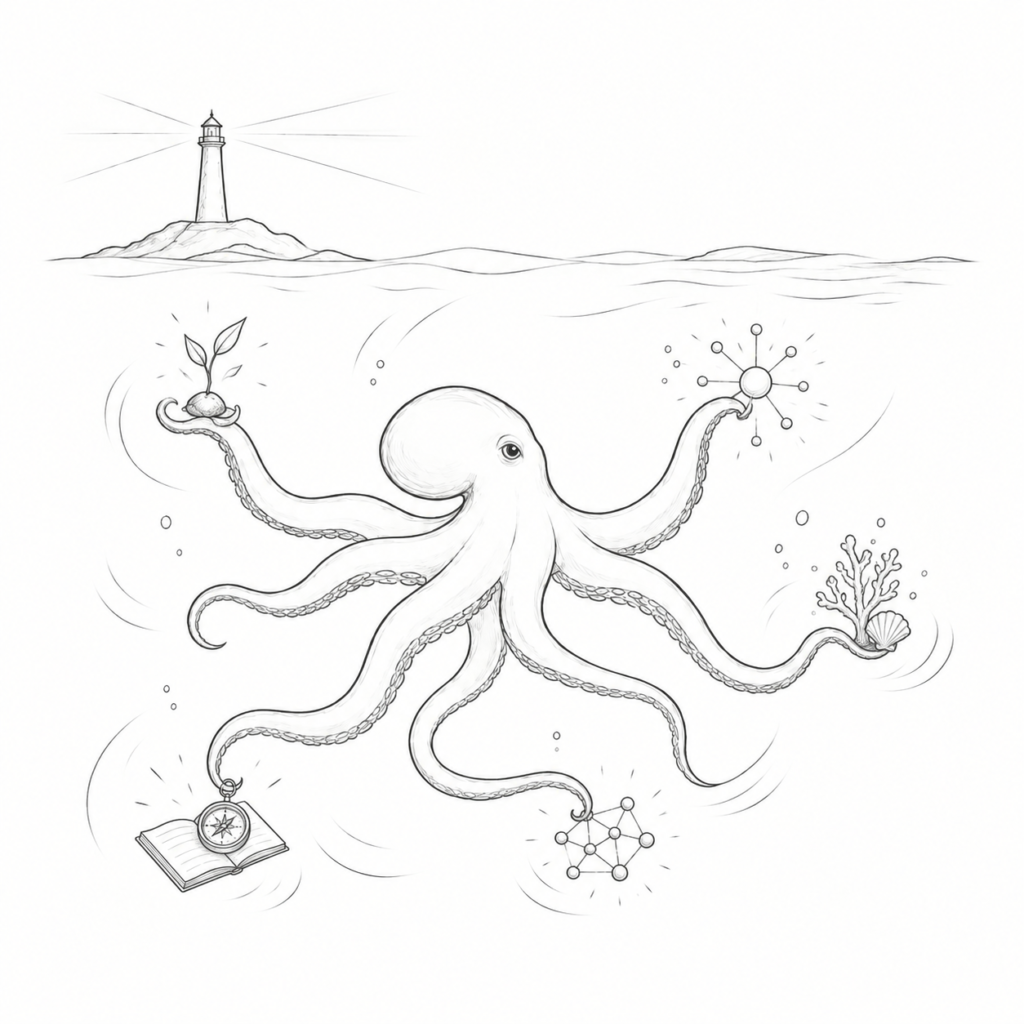
octopus organizations work differently. an octopus doesn’t coordinate its arms through a central command issuing instructions to each one. instead, most of its neurons live in the arms themselves, sensing and acting with independence, then feeding back into the body that still somehow moves as one. innovation, similarly, does not happen within an “innovation” department; rather, it’s distributed to whoever is closest to the problem. they spread, not scale.

As Werner and Le-Brun put it:

a complex world, however, is more like the ocean, the home of the octopus—where a small shift in the current can create unpredictable effects miles away. The shifts and unpredictability make it difficult to navigate; you can only sense, respond, and learn from the flow.

This is, i think, why RCTs struggle so much with teaching and learning as a research object. i had a conversation a few months ago with my advisor Prof Candace Thille on this. in short, RCTs work beautifully for mechanistic systems, where you can isolate a causal chain through control. BUT! education is a complex, adaptive system—and context varies! we have different institutional structures, class cultures, rubric formats, assessment values, curriculum design, student competencies, teacher attitudes, and so on… even under tight experimental constraints, people don’t behave mechanistically. they are people—embedded in complex adaptive systems that exhibit these features:10

  1. emergence: higher-level patterns arise from countless lower-level interactions, rather than being designed in directly. e.g., in my capstone, i defined and built four modes for the teaching assistants to collaborate with AI; but when i clustered their actual behavior, entirely different behavioral patterns emerged instead, cutting across my predefined modes.
  2. feedback loops: those emergent patterns loop back and reshape the very structure that produced them. e.g., when one teaching assistant rejected the AI-enhance mode outright (“enhance by what standard?”), her pushback fed directly into the next iteration’s design.
  3. attractor states: recurring patterns that persist across different starting conditions, shaped as much by the people inside the system as by any structure imposed on it. e.g., regardless of whether the teaching assistants were randomly assigned the modes or were allowed to choose, they kept settling into the same behavioral clusters.

all of this is to say that educational contexts are too complex and emergent for a single validated product to install cleanly everywhere top-down. instead, we should create the conditions, parameters, and possibility spaces that facilitate each context arriving at its own version, often in a scaffolded yet organic and serendipitous way.

put another way, we should shift our mindsets from scaling a product to spreading practices. and if we do build anything at all for “education innovation”, it should serve two processes:

  1. divergence—probes for more generative practices that give rise to new possibilities (pockets of local innovation)
    • does it prompt a user to reflect and develop a new POV on their current approaches to teaching, learning, or educational support?
    • does it create room for the user to push back on the system design, rather than simply comply or ignore?
  2. convergence—infra that documents evidence, synthesizes insights, and enables others to fork approaches (fabric of shared practices)
    • are user overrides recorded, and what do they tell us? are they failures or discoveries?
    • are we documenting the variations and the greatest common divisor across how a tool gets adopted in different contexts through different practices? what are the shifting parameters? what are the invariant parameters?

In this way, we engineer serendipity by allowing the system design to meet, morph, and co-evolve with practices—which, btw, i think informs us on how we might rethink the role of AI.

much of what i wrote above is more possible now than it’s ever been with AI. We can build probes and infra fast by iterating, prototyping, and testing them again and again with users across different contexts.

However, our perception or measure of “innovation” still hinges largely on how much AI we can stuff into a product. I don’t think it should be about that. rather, innovation is about new ways of seeing, doing, imagining. And that takes more generative practices than generative AI.

Minds Studio AI Communities of Practice

The AI Practice is a series of seasonal, theme-based communities of Practice, shaped collectively though facilitated discussion and experimentation. In these practices, the process of building together is not just a means to an AI product but and end itself, helping us as a community apply a new lens, slow down, and move with more composure and clarity in our own human practices.
Lighthouse letter V – Equinox 2026

Did you notice anything change for you as the solstice passed into equinox? I want to be purposeful with this question. I’m not marking a specific seasonal change, like a switch was flicked. I’m asking you to bring your attention to the past season. I’m asking you to sit a moment longer with where you’re at and what brought you here over the last few months. And while I’m not attaching equinox to a specific season (depending on the hemisphere), I do want to attach it to a vernal sentiment, a sense of being refreshed and new beginnings. Hope. And encouragement.

What have you learned this past season? And more specifically, what is holding for you in this moment? Please pause, or take as much time as you need to sit with these questions. I would even encourage you to open a new spread in your journal to write down all of these questions. However, please give yourself time to let the answers come. Or, simply don’t write anything else. 

Just sit.

As I write this, unfiltered, stream-of-thought reflection, I am reminded that I am actually writing this letter to myself. It might sound like a silly device, but when I generally write, I selfishly write for myself. Nevertheless, you are reading this, too, and I’m therefore warmed by the idea that you will also be sitting with these questions, blank journal open, pondering, waiting, meditating, and waiting some more. Like me.

Together, we wait. 

When I first set out to write this letter, I had several ideas and angles ranging from what agentic learning is to its inexorable political nature. Yet, something kept each lofty draft from reaching its end. It was as if time was saying, “Not yet.” There is irony in that if I’m allowed to privately laugh at my own accidental joke. Still, “not yet” aligns so much with how we learn, how we refine, how we eventually nod to one another in silent consensus, “OK, it’s ready.”

Another version of my letter wanted to express my gratitude and appreciation for the “sovereign generation,” a wonderful, impactful, driven, and ever hopeful cross-section of human beings who refuse to perpetuate, much less abide by the broader learning approaches none of us chose for ourselves. If you’re reading this letter, you are most likely one of them. And so I am ever grateful for what you do because it helps me to do what I do. Only together are we all able to step outside preset boundaries, ask unwelcome questions, sit with uncomfortable space, and create unimagined ways of learning.

Together, we expand horizons.

Minds Studio just held space for their members to collectively sit and reflect on the past season. Our humble gathering is also a way to remind ourselves of how to “be” as our lives are continually pulled forward moment by moment. Each of us, within Minds Studio or not, is navigating so many unspoken things, many of which we are barely able to review in those moments. And then we collectively pause. We share our vulnerability.

Together, we struggle.

As one person shared with me over the summer, “This space is precious.” For me, that really begins to touch something sacred. Through this gathering, as well as our other daily practices inside Minds Studio, we experience the collective “not yet,” patiently working through ideas which themselves beg purposeful consideration until we reach that collective nod, “OK, it’s ready.”

Together, we welcome the new day.

As I start this equinox with a refreshed perspective and a private, internal practice that can start my morning, I sincerely wish the same for you. We can only be to each other what each of us deserves if we each have and maintain our own sacred space starting our day. All learning innovation and designs aside, I am convinced the better we are at that, the better everything will be this equinox.    

Thank you for following and reading our letters.

Would you like to read our lighthouse letters in full? Subscribe for free here.

Lighthouse letter IV – Tribute to our mentors – François Taddei

Minds Studio Communities of Practice always start with a question.

Earlier this summer, a session started with: “Who is a mentor who helped you, and what impact did they have?”

One person talked about an aunt, another about a music instructor, another about a teacher they had at school. You learn more about someone from that than from any job title.

I’ve had a few mentors, at different stages of my life. That day I talked about the one who shaped the work I do now: François Taddei, founder of the Learning Planet Institute (LPI) and renowned researcher in evolutionary systems biology.

I met François in 2018, as a Learning Sciences student at LPI (still called CRI back then). On our first day he gave the opening talk. We were the first cohort in the new sustainable campus in the Marais, in Paris. One of his dreams was coming to life, and you could tell he was already dreaming about the next one, with us in it.

He insisted on why we were there: not to become the best IN the world, but the best FOR the world. He believes a better future is built with young people, not for them. The whole point of LPI is to give people the space to question, experiment, co-create solutions, and to leave better equipped to take care of themselves, others, and the planet.

Even more than his ideas, what stayed with me is his way of being, and how much he cares about the learners. Despite his incredibly busy schedule, he’d very often come to the Learning Center (LPI’s multiuse “library”), take off his shoes, sit on the sofas with students, and ask questions in a very Socratic way until you found your own answer. It’s also how he found his own. Ask him what LPI should do next, from repurposing a room to the whole institute’s strategy, and the answer was almost always “let’s ask the students.”

After graduating, I worked with him on the Learning Planet MOOD (Massive Open Online Documentary), and then on the first edition of the Learning Planet Festival with UNESCO. One more of his crazy ideas, which this year brought together 800+ events and 100,000+ participants from 193 countries.

A few years later I joined Minds Studio. A lot of what I do here still comes from LPI: the learning sciences, the collective intelligence methods, and the habit of asking the learners first.

Meeting François changed the direction of my life. And to this day, when I’m stuck on something, I often think: what questions would he ask?

We don’t just learn from our mentors; we act so we can make them proud. So to François, and to all the mentors behind the people at Minds: thank you. We’ll do our best to be worth the time you gave us, and to build a better future.

And you? If you feel like it, hit reply and tell me about one mentor of yours. I’ll write back.

Would you like to read our lighthouse letters in full? Subscribe for free here.

By: David Pontalier

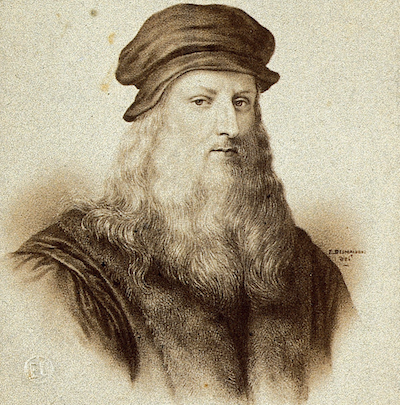
The Lighthouse Letter III – To Leonardo da Vinci

Dear Leonardo di ser Piero da Vinci, 

It’s already unbelievable that we’re writing a letter to you in 2026 when you departed this world in 1519. However, very few people in history represent so well the spirit of craftsmanship and the practice of principled curiosity you embodied, so this first honorary lighthouse letter is addressed to you.

For those who’ve not had the chance to learn about your story, let us share a few lines about what you did with your life. In approximately 67 years, you painted the Mona Lisa (1503-1519), drew the Vitruvian Man (1490), engineered a flying machine, a rudimentary submarine or a self-supporting bridge (amongst many other inventions) and wrote more than 13,000 pages of pioneering concepts in anatomy, hydraulics, optics, geology, astronomy and mechanics. Not bad at all for someone who was the illegitimate son of a notary in Tuscany, who at the age of 14 walked into a workshop of Andrea del Verrocchio, in Florence, to learn his craft as a humble apprentice.

Your observation, hands-on making, artistic judgement, scientific investigation and collaboration across disciplines are definitely an aspirational north star for many of us. Even the fact that your work was developed in collaborative environments (bottegas) where masters, assistants and apprentices contributed to commissions together is, in essence, at the heart of what we do at the Studio five centuries later. The Medicis now have different names, but the dynamics of the profession have not changed much...

Would you like to read our lighthouse letters in full? Subscribe for free here.

By: Alvaro Sanmartin Cid

Leonardo da Vinci’s picture file is licensed under the Creative Commons Attribution 4.0 International license. This file comes from the Wellcome Collection, a website operated by Wellcome Trust, a global charitable foundation based in the United Kingdom.

The lighthouse letter II

Welcome back! If you’re new here, this is Minds Studio’s beam of light, sent out roughly twice a month, written by someone in our network, for people who feel aligned with what we do even if we haven’t met yet.

I’m Belle, nice to e-meet you. I’d much rather make you a good cup of coffee and have a face-to-face chat, but maybe next time?

It’s hard to talk about Minds Studio without going back to my own mind. I am an immigrant – twice over, in fact. Artist, queer, dog lover, and a millennial who had to face all those soul-sucking jobs just to keep paying rent. Who didn’t?

Rushed to deliver, to find more clients, to multitask, maximising the efficiency at minimum cost. Twenty phone calls while on holiday, managing a team of 25 people at 24, in my third language. I do love a good challenge, but since joining Minds I realised that’s not the way I want to keep going, and thanks to the universe, I found there are more like-minded people out there.

And that goes beyond my professional life. I didn’t have a particularly good experience studying myself. I ended up paying money for a well-engraved trauma that, to this day, I’m still working on dissolving. Experiencing a communal way of learning changed everything –  the approach, the rhythm, the humanness. It’s beautiful and long-lasting. Minds shaped me so strongly that it made me want to be part of a Community of Practice for every topic I’m curious about…

Belle Sacchi

Would you like to read our lighthouse letters in full? You can subscribe for free here.

The lighthouse letter I

Welcome to Minds Studio’s first lighthouse letter. This message -in a virtual bottle- is our first beam of light to keep in touch with people we crossed paths with before- and some we don’t know yet- who feel aligned with Minds Studio’s purpose. You’ll find here our most personal reflections, the companies we admire, some projects we feel proud of, and a collection of our Minds Network members’ stories.

We aim to share our thoughts twice a month, but that’s not a promise- we believe we’ll find our own rhythm, and we all know that sometimes life gets in the way (in a good way). All our letters will be imperfectly human-written by someone in our network. If you resonate with any of them, we’d love you to respond with a letter of your own! (When was the last time you wrote one?)

Smiling person with short dark hair wearing a white collared shirt against a light background

The Studio was born in 2019 from a personal need to build lasting learning experiences I could feel proud of. Not yet another course. Not a rinse-and-repeat curriculum. I wanted to design something deeper and more meaningful, although I didn’t know the shape of it back then. Slowly, it’s grown to be a space for calm, humanity, depth and craftsmanship for many-including myself. As the years passed and the AI rush accelerated, I caught myself thinking about our role as humans and doubling down on the values we’ve always stood for. We need to focus and do fewer things better, not more things worse.

Great artisans have always kept and honoured this wisdom, surviving centuries of social upheaval, economic crisis, and technological evolution. Not by resisting change, but by holding firm to something deeper than the present trends: curating with care over mass production, cultivating relationships over transactional business, focusing on craftsmanship over convenience. This is not a price point. It is a philosophy. And it is, above all, timeless.

Is technology reshaping the way we learn? Undoubtedly. Much like globalisation reshaped fashion, making everything faster, cheaper, and more abundant-but not better. The world has been flooded with instant knowledge and frictionless answers. And like fast fashion, much of it will not last because it’s not about finding answers but exploring questions. Here is what no algorithm can manufacture: the feeling of a room where something shifts, a moment when we quietly experience something unique that changes the way we see the world. Those shifts arrive slowly and then suddenly, due to a particular alchemy of curiosity, human presence and shared discovery emerging in an environment that no technology has yet found a way to replicate-because it was never about technology in the first place. It’s a spark that suddenly lights up and changes the world you can see.

That is the light Minds Studio has always been searching for and beaming out, wherever we go. Our power lies in a collective that has always set its craft apart from the mainstream: bringing with us creativity, sensibility, and the patience to do things properly. Like many lighthouses, this approach may feel slow and somehow out of fashion, but some might find it life-saving.

Learning and making things that last move in the same direction. At Minds Studio, they always have.

Welcome to the first of the lighthouse letters, crafted to last.

Alvaro Sanmartin Cid

Subscribe to receive our next letter

Three important births and a dream

For those of you wondering if this is another AI-polished post, I’m sorry to disappoint. There’s only an imperfect amount of human juices behind the words you’re about to read.

I felt it was important to pause for a moment before coming back from my paternity leave to breathe and celebrate three meaningful milestones, all of them born out of love and nourished with care, effort and perseverance. I’ll also share some reflections of my journey at this point.


Starting with the most exciting one, I am celebrating the birth of my first son: Hugo Alberto. After a long wait, our son decided to join our family on the 17th of January, decreasing instantly our daily hours of sleep and work, and multiplying our hours of joy and kindness. Having a child is the most testing and beautiful experience of my life, and I feel such a deep satisfaction for being able to experience life to this intensity -even when it’s sometimes too much-.

This birth came at a very important maturity point in my life, and after a winding road. I’m soon going to be celebrating my own 40th birthday, and so instantly 2026 has become a very important transition year in my life, which I’m still trying to get used to.


The third birthday I’m celebrating is the 7th year of Minds Studio’s life, that I have found incredibly fulfilling too. I’m glad the Studio keeps growing in good health, as I believe we have also matured and grown a lot in the last few years.

Here are some of the main thoughts at this new stage in my life:

It took a -global- village


I would not be here, personally and professionally, without the support and care of many people scattered around the world, who helped me. I don’t have enough words to express how grateful I am to so many people. If you’re reading this, you’re probably one of them.

The Studio is now a collection of over 50 extremely talented minds (and hearts) who share something that’s very difficult for me to explain, like many of the important things in life. I like to say we are a group of independent professionals who care about their crafts, their learning and about each other. I imagine us as a distributed jazz band close to each other not by geography but mindset. Playing for those who can hear the music around the world.

But not only that, I am now part of a web of relationships with almost 50 forward-thinking institutions and companies in nearly 20 countries which you can visualise here:

48 projects across 20 countries

Our latest work is being delivered as you read these words in countries such as Japan, Hong Kong, South Korea or United Arab Emirates. It’s all happening slowly, carefully, and always with our highest standards of work and care to improve the way we learn, one project at a time. I sometimes can’t believe I get to work with such an inspiring group of people.

Now that our principles and brand are starting to mature I’ve also taken some steps -and resources- to strengthen its resilience to protect it -mainly, from myself-. The first 5 years Minds Studio was very dependent on my contribution, but as we grew I’ve spent more time with the core minds of the network to evolve our community architecture and redistribute workload and rewards.

It took experimentation, pain and practice

I have always tried to stay true to myself, and therefore listen to my internal compass which meant I was lost several times in life. Things have never been a straight line or a master plan calculated to the latest detail in my head. I needed to think but I also needed to feel it, or I needed to stop. At critical points, being this way meant that pain was unbearable by being alone and some key people showed up, helping me get unstuck and soothing the pain.

The Studio is, of course, a reflection that very same character, and attracts people with a similar mindset. It’s taken several years of research and execution to be able to express the kind of learning experiences we collectively stand for, but even now it keeps evolving like a living organism, as we all carry different experiences and points of view. Despite new tools and technology constantly appearing, our Practice approach remains a solid anchor to enjoy learning a new skill, in the company of others who are in a similar journey.

I believe we can help many, many people reconnect with their curiosity and learn valuable skills with this approach. I believe in it because it’s based on human connection, emergent learning, and gentle guidance by facilitators and tools that provide structure, rhythm and a reminder that the most difficult part of learning is and will be showing up to it, again and again.

It took a craft mindset and patience

I love to spend time with anyone who cares about a craft, and I wish everyone could feel how real craftsmanship feels like. It’s kind of magical, or spiritual. I believe technology won’t ever change it -but will always expand it-. When someone speaks from a place of depth and breadth of knowledge, it makes a hell of a difference, particularly when stakes are high. Unfortunately technology keeps pushing us for the quick answer, for the superficial solution.

I wanted the Studio to become a home for those people in search for depth, so we can produce experiences that push the boundaries of what’s been tested before. This means we can’t work on many projects at the same time, we choose quality over quantity. It’s taken seven years to find 30 clients and 50 people with this mindset, but we are not in a rush.

The dream

Today I dream Minds Studio becoming what Walt Disney would imagine if he was obsessed with education, not with animation. A Studio where, every year, craftsmen and women produce a few mind-blowing learning experiences that inspire people to follow their curiosity anywhere in the world.

Part of that dream means that we inspire people to find their craft and practice to become a better version of themselves on a regular basis.

I commit to keep showing up. It’s the best way I can think of setting a good example for Hugo.

Bridging the Third Digital Divide: Reflections from my AI Bootcamp Journey.

Last night at 4:45 AM I presented my capstone project and completed my first Maven Bootcamp, thanks to Learnest.

What key concepts did I learn?

As I have already talked about the first part of the bootcamp, I’ll focus on some of the most valuable concepts and principles I’m taking with me:

  1. We are inevitably facing a new divide
  2. Equitable access to AI matters and frameworks
  3. The AI practitioner learning curve: From prompting to fine-tuning

1. The AI divide

The deeper I explore this tool, the more similarities I find with all the other waves we’ve gone through, particularly with the internet wave.

As described by Brookings, we are inevitably approaching a new iteration of the classic “digital divide”, that allows some people access exponential benefits in productivity, opportunities and progress, while the majority struggles to keep the pace and struggles to stay competitive. In a nutshell:

The first digital divide: The rich have technology, while the poor do not.

The second digital divide: The rich have technology and the skills to use it effectively, while the poor have technology but lack skills to use it effectively.

The third digital divide?: The rich have access to both technology and people to help them use it, while the poor have access to technology only.

In the Studio language, I’d say that the third digital divide is between those who have a learning AI community, and those who don’t.

2. Equitable Access to AI

Although all the economic and societal forces seem to be doomed to push us towards an -even more- polarised world with just a few benefiting from this powerful tool, I choose to keep a tiny light of cautious optimism for the human potential it brings. Here’s why I remain cautiously optimistic:

What does equitable access mean in an educational context?

Equal access to the BENEFITS of a product, service, resource, solutions that improves educational outcomes.

If we don’t do anything different, AI won’t level the playing field. As we are starting to see with the AI products and subscriptions, only those who can afford them will have access to the latest version to it. This will accentuate the differences between rich and poor. The same old story.

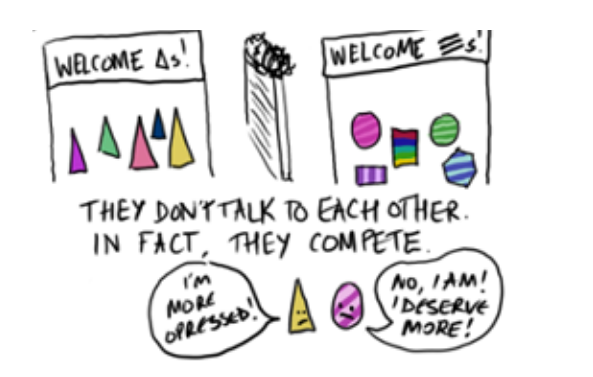
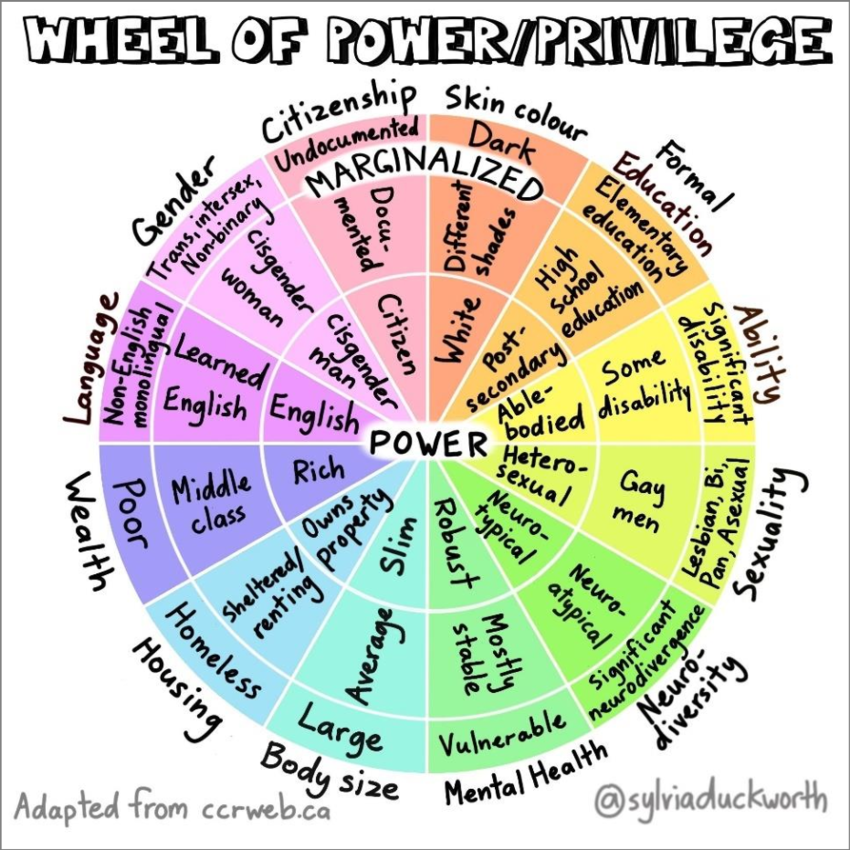
However, I’m happy to learn about frameworks such as Intersectionality (Kimberlé Crenshaw, 1989), whose core idea is that people are not defined by a single identity factor—like race, gender, class, sexuality, disability, or age—but rather by the combination of all these factors. These intersections can amplify privilege or disadvantage in complex ways.

How might different students experience the same AI tool differently based on their intersecting identities?

Also, it was very useful to learn about the Wheel of Power (Sylvia Duckworth, 2022) and the Matrix of Domination (Patricia Hill Collins, 1990), that explain how systems of oppression (racism, sexism, classism, ableism) operate at personal, cultural, and institutional levels simultaneously. 

In AI edtech, this helps us understand how technologies can reinforce oppression at multiple levels (e.g., individual bias in AI recommendations → institutional power in determining who controls educational data and use).

The final concept of this module was about Design for Justice (Sasha Costanza-Chock, 2020), which provides actionable principles for equitable technology development by centering marginalized communities, prioritizing impact over intentions, and honoring existing knowledge systems. 

Design for Justice is a Framework and a Practice that:

  • Analyzes how design distributes benefits and burdens between various groups of people
  • Focuses explicitly on the ways that design reproduces and/or challenges the matrix of domination
  • Ensures meaningful participation in design decisions and recognizes community-based, practices

3. The AI Practitioner learning curve

This was probably what I was looking for when I decided to take this bootcamp. What are the different “layers” that we need to learn when we aim to master AI? Here’s what I found:

1. Prompting: The first step is to learn how to prompt a Large Language Model (Such as the ones of ChatGPT, Gemini or Perplexity) properly. Developing this skill is crucial, and we’ll probably equate it at some point to learning “AI language” as if it was English or Portuguese.

2. RAG (Retrieval Augmented Generation): This second step is about enhancing the Large Language Model with additional specific knowledge that will provide more context and personalisation to the LLM.

3. LLM Workflows: Once we know how to prompt and augment a Large Language Model, the next step in the learning curve is to concatenate Augmented LLMs to provide an accurate adaptive solution to a problem.

4. Fine-Tuning: The last layer we discussed at the bootcamp was about Fine-tuning, which means “rewiring” the LLM using more datapoints that were not available to the LLM before, or synthetic data that we’ve generated.

    Each of those stages require a considerable amount of time and effort to achieve mastery, which brings me to my final point.

    Tools change, principles remain

    During my conversations with other Edtech practitioners, we agreed that the most difficult part is to remain principled and not to look for quick answers, fixes or solutions without critically evaluating the output of the tool.

    In order to build sturdy and durable houses, you must learn certain principles. Mathematics, Physics, materials, etc. Learning principles is not easy, and it is not fast. It requires dedication and practice. Someone who has mastered the house-building principles will be able to build a small countryside house and a fancy tower in Manhattan. The tools change, the principles remain.

    And this is my last reflection of this course: We can’t just learn to use the tool, because the tool will own you and you’ll depend on it. However, if you learn the principles, this tool will elevate you to a level you’ve never experienced.

    The AI Learning Group at Minds Studio

    As I said in my previous post, Minds Studio is not going to become an AI-first company -the same way it’s not “internet-first” either.

    However, I’ve started a new Practice where those of us interested in master AI tools come together regularly to help each other integrate it with our own professional activities.

    My Capstone Project

    In order to make my capstone project relevant to the problems I’ve witnessed while running Communities of Practice, I decided to spend some time building a tool that helps students log their “aha! moments” and “paradigm shifts” in order to visualize their transformation over time. I’ve called “Significant Change Tracker”, as it uses a methodology called Significant Change on top of an LLM to make it conversational.

    You can take a look and play with it here.

    The first AI development at the Studio

    As part of the strategic reflection of Minds Studio’s value proposition and positioning in this new era of AI, I’ve been taking the Responsible AI Bootcamp for Edtech practitioners.

    In just a couple of weeks, I’ve built and published a tool that helps a literature teacher prepare culturally responsive lesson plans and assignments for any book, tailored to the age and country of origin of each student.

    You can play with it here:

    It’s still a very basic tool, created primarily to experiment with Dify– an Open Source Platform designed to simplify and accelerate the development of AI-powered applications.

    Being a tinkerer

    It’s definitely exciting to play with powerful new tools, but I remain firm in my conviction that technology alone will not change the world—technologists might make it a tiny bit better.

    A concept that I learned in this course – thanks to Justin Reich’s paper – is that of being a Tinkerer. Quoting Justin “Tinkerers see schools and universities as complex systems that can be improved, but they believe improvements come from many years of incremental changes to existing institutions rather than from wholesale renewal.” This stands in contrast to the charismatic stance that ascribes tremendous power to new technologies to reinvent education.

    Choose your favourite LLM -biases

    Once you start digging deeper on how LLMs are built, and the potential sources of downstream harm, you realise it’s all a game of choosing priorities—and it’s a very tricky game to play.

    Should a model be inclusive? Sure.
    Should it be fair? Absolutely.
    Should it respect privacy? No doubt.

    The problem arises when one choice influences others. For instance, more privacy might mean lower data quality, especially if we want the LLM to be truly inclusive or to consider historical biases.

    The entire process of building an LLM—from data collection to processing, model development, evaluation, postprocessing, and deployment—involves a staggering number of decisions. Balancing them is incredibly difficult.

    Adding knowledge on top of an LLM

    It’s been fascinating to explore the concept of RAG (Retrieval Augmented Generation). Since LLMs are trained on broad- though massive- datasets, it’s often necessary to provide an additional layer of domain-specific knowledge to improve their performance on particular tasks.

    For example, in the tool I mentioned earlier, I added documentation- “knowledge on top” of the LLM (ChatGPT)- about cultural differences and widely known K–12 books. This helps the model retrieve more accurate and relevant responses.

    Are we going to be AI-first now?

    No.

    We are experimenting with AI, but the purpose of the Studio remains unchanged by any technological wave, no matter how big it is.

    We remain focused on sparking human curiosity and bringing to life exciting, inspiring communities of learners who regularly practice something they want to learn.

    I’ll continue to share learnings from this journey.

    2024 at Minds Studio

    The year that AI took the world by storm, we decided to double down on our human community and international expansion.

    The 1 minute summary

    I’m proud to share that Minds Studio is now working with a network of over 50 professionals in more than 20 countries to build communities of practice for some of the leading and most fearless educational institutions and businesses in Europe, the UK, the US, and Asia.

    Over the past year, we’ve focused on expanding the Minds Network to more than 10 new countries. The network’s current distribution is approximately 25% North America, 25% Europe, 20% UK, 12% Asia, 10% Africa, and 8% Latin America. We’ve also developed a new Community of Practice framework -which we’ve decided to open source at the Minds Hub-, and have been using it to serve our growing customer base in Spain, England, Switzerland, France, Hong Kong, and the USA.

    I want to extend our heartfelt thanks to UNIR 🇪🇸, Minerva University 🇺🇸, The London Interdisciplinary School 🇬🇧, Villanueva University 🇪🇸, The Earth Foundation 🇨🇭, Purpose in Motion 🇭🇰, Beyond Education 🇫🇷, and Leemons 🇪🇸 for their continued trust in us throughout 2024. More than 50% of Minds Studio’s clients this year were returning clients, and 40% have trusted us for over a year. Without you, we couldn’t do what we love.

    Through our research, design, and implementation of communities of practice and learning models, I estimate that over 10,000 learners benefited from Minds Studio’s efforts in the last 12 months. In 2025, we’ll continue to deepen our contributions through our regular practices, sparking curiosity in learners around the world.

    We look forward to welcoming organizations and institutions ready to move beyond fear-based education systems into ecosystems that cultivate curiosity and creativity.

    Thank you for being part of our journey.

    Alvaro Sanmartin Cid

    Minds Studio Founder