Global Alliances
University 2026
INTRODUCTION
Higher education is currently undergoing a consolidation process similar to that experienced in other industries such as aviation, telecommunications, or banking in the past — but this time, accelerated by the paradigm shift brought about by Artificial Intelligence.
Traditional local universities have seen student demand decline in recent years across many markets (especially in the U.S. and parts of Europe), while competition to attract them has intensified in their traditional territories 1. Students today have access to increasingly personalized educational pathways and new value propositions for learning. In addition to international options (with major global leaders such as Harvard, Imperial College, Stanford, Oxford, Princeton, Cambridge, MIT, etc.), new players have emerged offering more flexible, short-term, and employability-oriented formats (Alternative Universities, Technology Companies, Bootcamps, Apprenticeships, etc.).
Many of these factors, combined with demographic changes 2, have led the higher education sector to begin showing signs of consolidation, including closures, mergers, and acquisitions. In the private sector, several international investment funds are already injecting capital into large institutions to forge alliances, create major groups, and absorb smaller projects that cannot compete without significant investment 3.

ai as a catalyst
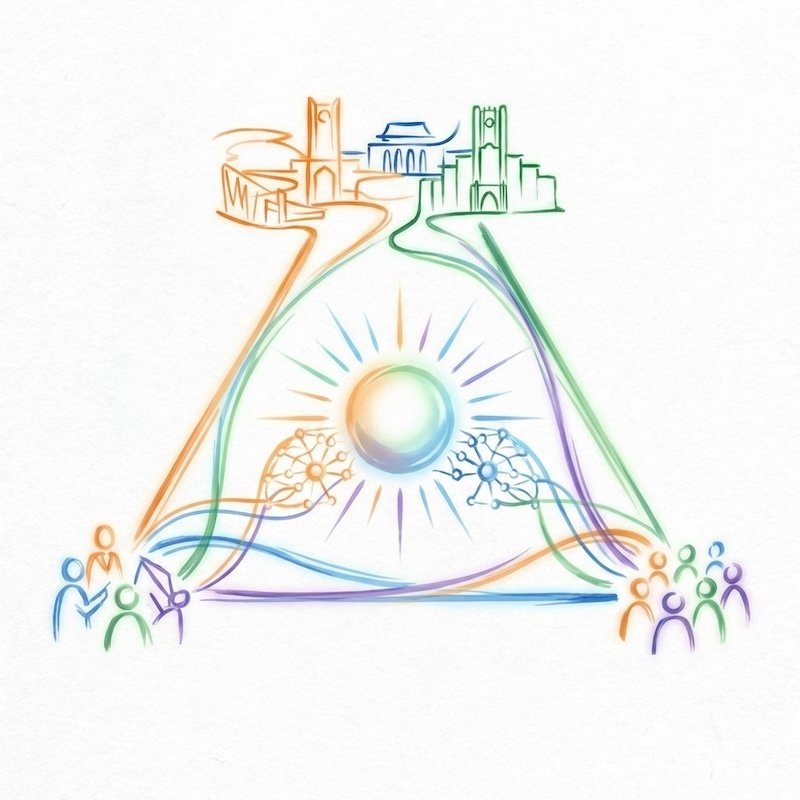
Actors within the higher education market now seem to be looking beyond their borders and joining forces to find solutions together. Just as in the 1990s telcos such as Telefónica embarked on mergers and acquisitions in Latin America and Europe (VIVO in Brazil, O2 in the United Kingdom), or national airlines formed global alliances (Star Alliance in 1997, OneWorld in 1999) to compete internationally, it now appears that the higher education sector’s turn has come to consolidate its own global alliances. The years following the 2020–2021 pandemic and the explosion of AI-based tools have brought turbulence and uncertainty, whose full impact is still being assimilated 4.
For this reason, in this issue of Nueva Revista we believe it is time to examine some of the global university networks that are already consolidated or emerging, led by different institutions across various regions. The four we will study in this edition are:
ECIU University
ECIU University (Europe): A transnational European alliance model focused on research, micro-credentials, flexible learning paths, and challenge-based learning that together create a “competence passport.”
Future Universities Alliance
Future Universities Alliance: An emerging alliance centered on shared learning among both established and emerging institutions in need of reinvention, committed to the idea of “rooted globalism.”
Global Alliance of Innovative Schools
A global alliance of innovative schools emphasizing pedagogical transformation and the creation of joint working groups.
Universitas 21
Strategic internationalization through multilevel (“nested”) networks and regional leadership driven by Tecnológico de Monterrey.
These are by no means the only existing alliances, but they will certainly allow institutional leaders and education policymakers to reflect on the movements currently shaping the sector. When Michael Crow, president of Arizona State University, states that universities must “evolve or die” 5, he captures the existential imperative driving higher education’s transformation today.
Sources:
- Anthony P. Carnevale, Michael N. Lovell, and Jenayoe D. Smith, “Promising Solutions to Reverse College Enrollment Declines,” Brookings Institution, October 13, 2024, https://www.brookings.edu/articles/the-case-for-college-promising-solutions-to-reverse-college-enrollment-declines/.
- Western Interstate Commission for Higher Education (WICHE), “The Total Number of High School Graduates Is Expected to Peak in 2025, Then Decline Through 2041,” Knocking at the College Door (Key Findings), December 10, 2024, https://www.wiche.edu/knocking/key-findings/graduates/
Scott White, “The Enrollment Cliff: How Fewer Applicants Are Reshaping Higher Education,” Forbes, February 9, 2025 (updated February 19, 2025), https://www.forbes.com/sites/scottwhite/2025/02/09/the-enrollment-cliff-how-fewer-applicants-are-reshaping-higher-education/;
Jessica Dickler, “‘A Perfect Storm’ — More Colleges at Risk as Enrollment Falls and Financial Pressures Mount,” CNBC, September 30, 2025 (updated October 1, 2025), https://www.cnbc.com/2025/09/30/colleges-at-risk.html.
- Michael Sadoff and Ari Solomon, “How Mergers and Acquisitions Are Reshaping Higher Education,” Loeb & Loeb, January 5, 2025, https://www.loeb.com/en/insights/publications/2025/06/how-mergers-and-acquisitions-are-reshaping-higher-education
- University of Michigan AI Research Lab, “National Survey of Higher-Ed Leaders Captures the Trends, Priorities, and Challenges in Innovation,” 2024, https://ai.umich.edu/blog-posts/national-survey-of-higher-ed-leaders-captures-the-trends-priorities-and-challenges-in-innovation.
- Bryan Penprase, “‘Evolve or Die’ — Michael Crow’s Challenge to U.S. Higher Education,” Forbes, May 1, 2025, https://www.forbes.com/sites/bryanpenprase/2025/05/01/evolve-or-die–michael-crows-challenge-to-us-higher-education/.
Universidad 2026 is a publication by:
Nueva Revista
Nueva Revista is a Spanish publication dedicated to analyzing contemporary society, focusing on culture, humanities, science, art, and politics. It offers in-depth analysis and expert perspectives on topics such as higher education innovation, technological advancements, social change, and public policy. Featuring contributions from renowned academics, writers, and thought leaders, the magazine fosters critical dialogue and intellectual debate, making it a key reference for those interested in the intersection of knowledge, society, and progress.
If you’d like to read this year’s edition of University 2025 in Spanish, please click below:

In collaboration with Proeduca
PROEDUCA’s objective is to provide the best online higher education to its students and it achieves this through educational commitments at three universities: The International University of La Rioja, the Online University of Mexico (UNIR Mexico), and CUNIMAD. It also offers studies located in Peru, at the Newman Postgraduate School, and in the United States, where it has a presence through MIU City University Miami.