
By: Kobus du Toit
How Do You Respond When You Lose the Path?
As I write this letter to you, I realise I’ve now taken part in over ten seasons of the Meta Studio since joining Minds Studio. As with anything in life, the more you do something, the more patterns you start to notice. Here are a few questions that keep coming back to me:
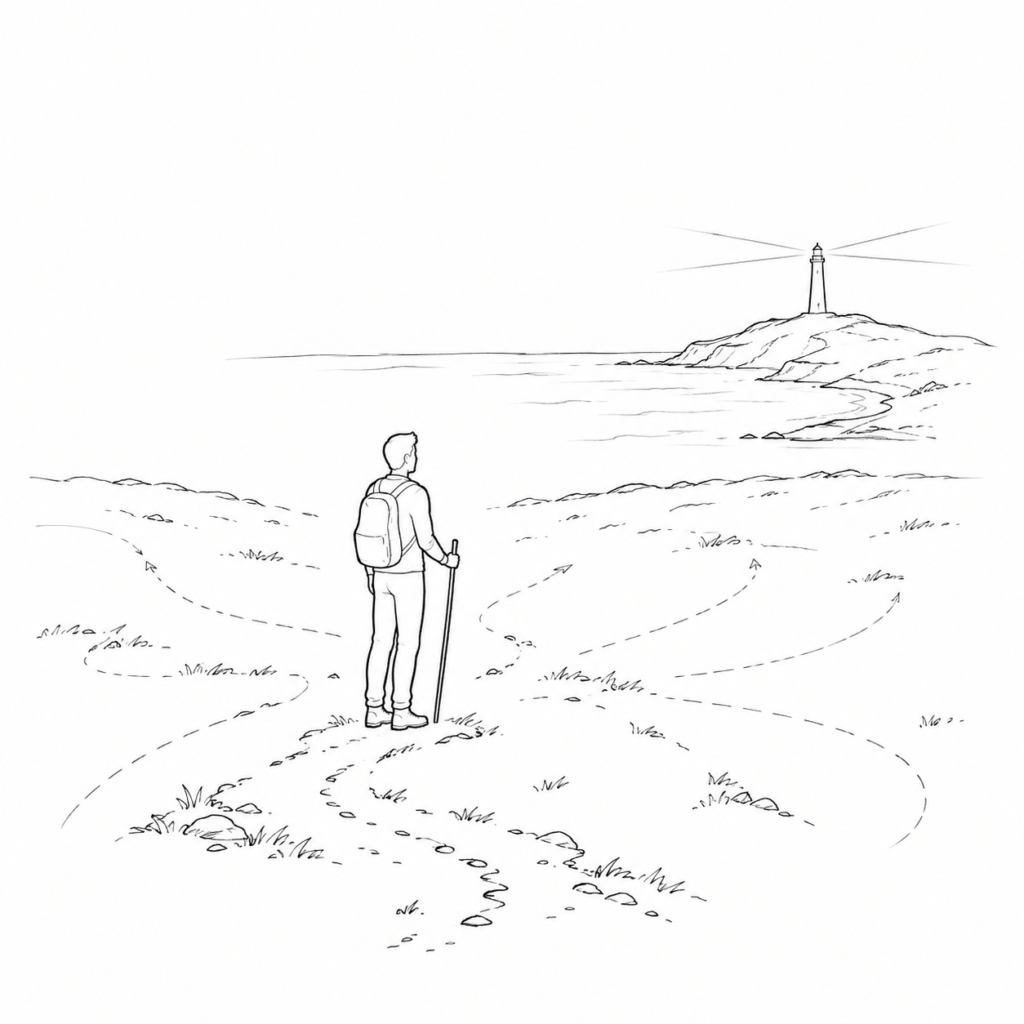
How do you respond when you lose the path, or don’t know where to go next? How long can you hold the discomfort of not knowing? And when you hold it long enough, what tends to emerge?
Holding the not-knowing
I’ve found a direct link between our ability to hold liminality and our capacity for breakthrough. When we jump to an answer too quickly, we usually end up repeating the past, and keep getting more of the same.
Breakthroughs happen when we stay open to being surprised and hold the tension of not knowing for long enough. When we make room for participants to bring in their lived experience, and they feel safe enough to share it, something special emerges in a group. We all get wiser for it. Sometimes all it takes is one “left field” comment for a group to find its momentum and enthusiasm again.
Life works the same way. We can’t control how it ebbs and flows, but we can spot the slipstreams and ride them when they appear. Yes, that means we’ll sometimes go down a rabbit hole or “lose the path”. But as Boyd Varty reminds us:
I think of all the people I have spoken to who have said, “When I know exactly what the next thing is, I will make a move.” I think of all the people whom I have taught to track who froze when they lost the track, wanting to be certain of the right path forward before they would move. Trackers try things. The tracker on a lost track enters a process of rediscovery that is fluid. He relies on a process of elimination, inquiry, confirmation; a process of discovery and feedback. He enters a ritual of focused attention. As paradoxical as it sounds, going down a path and not finding a track is part of finding the track.
Explorers, not experts
I’ve seen this play out time and again in the Meta Studio. We get stuck. We don’t know where to go next. So we sit in a moment of ma, and allow a deeper guidance or intelligence to emerge and show us the next step. But if we aren’t willing to sit with the discomfort, or to admit that we don’t know, we never create the space for those insights to arrive.
How willing are you to stand bravely at the edge of what you know?
One of our principles at the Meta Studio is “facilitators as explorers, not experts”. It has been a liberating principle to live by. It takes away the pressure to have the answer, and lets a group wrestle and discover together.
What I’ve learned is that facilitating groups in emergent spaces is a lot like tracking an animal in the wild.
The path of “not this”
When a great tracker loses the trail, he can still learn where the animal went by discovering all the places it didn’t go. In that moment he faces the full 360 degrees of possibility. The animal could have gone anywhere, so every patch of blank, trackless ground is speaking to him: not this path, not this path.
With every step, he rules out another wedge of the circle, narrowing in on the trail by learning where it doesn’t run. In this way, a tracker is always on track, even when he’s off it.
I’ve always wanted my life to be an expression of the things I care about. Sometimes, though, the way there began with imitating what I thought I should care about. Realising that some of those things weren’t part of my path was a gift. It helped me know myself far more deeply.
By following the imitation, my own trail twisted and turned before it opened into something authentic. No trail is ever wasted. Walking a life that isn’t yours can be the beginning of finding the one that is. The path of “not this” is part of the way of the tracker.
When I was in the thick of wrestling with all of this, I came across David Whyte, the brilliant Irish poet, and turned his words into a song. It’s a reminder to keep “losing the track” in my life, because then I know I’m doing something radical and courageous with it.
When the Path Disappears (ft. David Whyte)
With wayfinding wisdom,
Kobus
“I don’t know where we are going, but I know exactly how to get there.”
Would you like to read our lighthouse letters in full? Subscribe for free here.